When I started my 3.5 mm headset supply business six years ago, I thought the hardest part would be manufacturing a product that stood out in a crowded market. What I quickly learned was that convincing buyers—from small electronics retailers to individual content creators—took more than just good specs on a datasheet. It took proving that every headset that left my warehouse had sound quality that matched what we promised. Over the years, I’ve worked with audiologists, software engineers, and regular customers to build a testing process that’s repeatable, honest, and actually tells us how a headset will perform in the real world. Today, I want to walk you through that process, not as a textbook, but as someone who’s spent thousands of hours listening to these little devices, adjusting settings, and arguing with a software team about whether a midrange crack counts as a defect. 3.5 mm Headsets
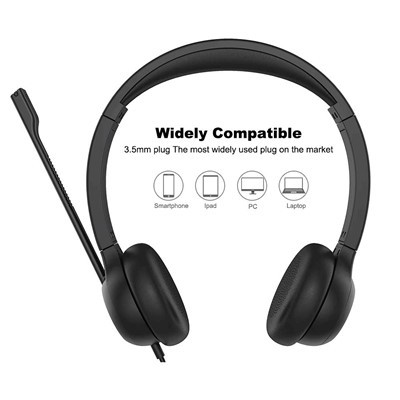
First, let’s get one thing straight: testing 3.5 mm headsets isn’t just plugging them into a phone and listening to a few songs. The 3.5 mm jack is analog, which means it carries every little imperfection from the source, the jack, the headset itself, and even the device you’re using to play audio. That’s why our process starts way before we ever let a tester put on a headset. We calibrate every piece of gear we use so that we’re not testing our equipment, we’re testing the headset. Our reference audio system, the one we use as a baseline, gets tuned once a quarter with professional calibration mics, and we log every change. No exceptions. If a new software update hits our test laptop, we wait three days to make sure it doesn’t mess with our output levels before we start testing. That attention to detail is how we’ve avoided shipping a whole batch of headsets that sounded fine on one laptop but muddy on another.
The first real test we run is what we call the “Baseline Frequency Response Check.” This is where we use test signals—sine waves that sweep from 20 Hz (low bass) up to 20 kHz (high treble), the range of human hearing—to map how each headset reproduces sound. We don’t just use any test software; we use a dedicated audio analysis tool that’s built for headphone testing, not just general audio. The mic we use is a calibrated artificial ear, the kind you’d find in an audiologist’s office, because it replicates the way sound actually hits the eardrum, not just what it registers on the outer ear. We place the headset perfectly on the artificial ear—no gaps, no squishing, because even a 1 mm gap can change the low end by a few decibels—and play each sine wave at a consistent volume. The goal here is to make sure the headset doesn’t have any peaks or dips that throw off the sound. For example, a peak at 3 kHz is what makes vocals sound harsh and fatiguing, while a dip at 80 Hz makes bass sound thin and weak. We set strict limits on these; if a headset’s response deviates more than 2 dB from our baseline, it gets sent back to the assembly line, no questions asked. Last year, we caught a batch of ear cushions that were slightly too thick, which dampened the low end by 3.5 dB, because this test caught it. That’s the kind of mistake that would have left customers complaining about weak bass, and we stopped it before it left our loading dock.
Next, we move to the “Real-World Audio Test,” and this is where the science meets actual listening. I could stare at a frequency response graph all day and tell you a headset looks good, but I need to know how it works when someone’s watching a movie, taking a call, or mixing a podcast. We use a curated set of test tracks that we’ve built over years—tracks that highlight specific aspects of sound. For bass, we use a remastered version of a jazz drum track with deep kick drums and warm upright bass. For mids, we use a vocal track where the singer is right up front, no reverb, so you can hear every breath and nuance in their tone. For treble, we use a classical string quartet recording, especially the higher violin lines, because even a tiny treble distortion will jump out here. We also include a field recording of a busy street—cars, people talking, birds—because one of the biggest complaints we get from casual users is that headsets either muffle background noise too much or let it in too much, making calls hard.
Here’s the part that’s not in the datasheets: we have a team of testers, all with normal hearing (we test their hearing once a year, just to be safe), and we don’t let anyone work on headsets for more than four hours a day. Listening to audio at high levels all day can permanently damage your ears, and we refuse to put our team in that position. Each tester listens to each track at two volumes: 80 dB, which is the OSHA limit for safe daily exposure, and 90 dB, which is a common level people use while commuting or working. For each track, they rate the sound on a scale of 1 to 10 for clarity, distortion, bass response, treble response, and call quality (though call quality gets its own separate test, which we’ll get to in a minute). We also ask them to take notes on anything that stands out—even a tiny pop, a crackle, or a feeling that the headset is “unbalanced.” Last month, a tester noted that a certain batch had a slight tinny sound when listening to podcast dialogue, which our frequency response test didn’t catch because it was only a 1.5 dB dip in the 5 kHz range. That’s the kind of thing only a human ear can pick up, especially when they’re listening to the kind of content most people actually consume.
Speaking of call quality, that’s a whole separate test we take super seriously. A lot of 3.5 mm headsets are marketed for both music and calls, but the analog jack means that any static, interference, or poor microphone placement will ruin calls. We test call quality in three different environments: a quiet office, a busy café, and a moving car on the highway. For each test, we connect the headset to a standard smartphone (we don’t use fancy lab phones, because most of our customers use regular ones), and we have a second phone on the other end of the line. The person on the second phone reads a script of everyday conversation, and our testers on the first end rate how clear it is, how much background noise they can hear, and if there’s any static or delay. We also use a tool that measures the microphone’s frequency response during calls, because a good call mic should pick up human speech (which is roughly 300 Hz to 3.4 kHz) without picking up too much ambient noise. A common mistake we see with cheap headsets is that they put a cheap mic on the cable, which muffles speech or picks up wind noise when you’re outside. We’ve invested in high-quality analog mics for our headsets, and this test ensures we’re getting the most out of them.
One step that a lot of suppliers skip is the “Durability and Long-Term Sound Test.” I’ve had customers tell me that a headset sounded great when they unboxed it, but after a few weeks, the sound went muffled or there was static. That’s usually from the jack, which is a moving part—you plug and unplug it dozens of times a year, and the pins can get bent, corroded, or loose. So we test each headset’s jack by plugging and unplugging it 5,000 times. That’s more than the average person will do in two years of regular use. After 5,000 plugs, we connect it to our reference system and run the frequency response test again. If the jack has developed any issues—like a bent pin that causes a dip in the midrange, or a loose connection that creates static—the headset gets rejected. Last year, we ran this test and found that a small batch of jacks had slightly loose pins, which would have caused static after about a year of use. We caught that before it got to our customers, and it saved us from a lot of returns. We also test the cables, because a frayed cable can cause muffled sound or cutouts. We pull on each cable with a consistent force for 100 cycles, and if any wires start to show wear, we switch to a thicker, more durable cable supplier.
We also do something that’s less about testing and more about validation: we send sample headsets to real users, not just other audio experts. We work with students, remote workers, and content creators who use 3.5 mm headsets every day, and we ask them to use them for two weeks in their real lives. A student might use theirs in a dorm room, where there’s a lot of background noise. A remote worker might use theirs for Zoom calls in a home office. A content creator might use theirs to edit podcast episodes. We ask for their honest feedback, even if it’s negative, because that’s the kind of real-world use you can’t replicate in a lab. Last year, a creator told us that our headsets made their voice sound “too boxy” when they recorded voiceovers for YouTube. We went back and tested them with a voiceover track, and sure enough, the midrange was slightly rolled off, which made voice sound boxy. We adjusted the equalization on our production line to fix that, and since then, that feedback has been a staple in our testing process for all new models.
Now, I know some of you reading this might be thinking, “This all sounds great, but it’s expensive. Why not just skip some steps to save money?” Let me tell you: when I first started, I skipped the artificial ear frequency response test. I only used human testers, and I shipped a batch of headsets that sounded amazing to my team, but when a retailer tested them, they found that the bass was 4 dB lower than advertised. The retailer sent back 200 pairs, and I lost money on shipping, restocking, and a lot of trust. That’s when I realized that combining scientific testing with real-world listening is the only way to get it right. The labs don’t lie, but the people using the headsets do too.
At the end of the day, testing 3.5 mm headsets is about making sure that every pair that leaves our warehouse works as hard as the people who use them. Whether you’re a student cramming for exams, a remote worker taking a dozen calls a day, or a musician editing a track, your headset should deliver clear, balanced sound every single time. We don’t cut corners, because that’s how you end up with headsets that sound good once, but not for long.

If you’re a retailer looking for a reliable supplier of 3.5 mm headsets, or a content creator who needs high-quality headsets for your work, we’re here to talk. We can send you samples, walk you through our testing process, and make sure you find the right headset for your needs. Don’t hesitate to reach out and connect with our team to start a conversation about how we can work together.
Single Ear Headset References:
ANSI/ASA S3.25-2012, Specifications for Headphones and Earphones
ISO 11904-1:2002, Acoustics – Determination of sound immission from sound sources placed close to the ear – Part 1: Technique using a artificial ear (IEC 60318-1)
OSHA 29 CFR 1910.95, Occupational noise exposure standards for hearing conservation
Huizhou Boxin Electronics Co., Ltd.
We’re well-known as one of the leading 3.5 mm headsets manufacturers and suppliers in China since 1989, also support customized service. With abundant experience, we warmly welcome you to wholesale high quality 3.5 mm headsets made in China here from our factory.
Address: No.01, 7/F, 5#, Factory 5# and 6#, Phase l, Lechuangcheng, No.8, Renluo 6th Road, Shuikou Street, Huicheng Distriet, Huizhou City, Guangdong Province, P. R. China.
E-mail: Info@ucheadset.com
WebSite: https://www.boxinheadsets.com/
